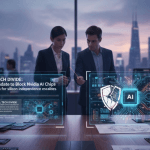
An engineer analyzes AI-powered digital twin models that strengthen supply chain resilience.
How do you manage a system that spans continents, relies on political stability, and can be paralyzed by a single ship blockade or a local labor dispute? This is the core question facing logistics and operations leaders today.
For years, the global supply chain was engineered for one metric, cost efficiency. The result was a fragile network built on “just-in-time” principles that shattered under the shocks of pandemics and geopolitical conflicts. Now, the mandate has shifted.
In 2025, the new global priority is Supply Chain Resilience, a state of engineered robustness that allows businesses to absorb major shocks without collapsing. The path to achieving Supply Chain Resilience is not paved with bigger buffer inventories or simple nearshoring. It lies in digital visibility and predictive intelligence.
By applying advanced technologies like Artificial Intelligence and Digital Twins, companies are moving beyond simple risk management to a state of proactive control, transforming logistics from a cost center into a strategic competitive advantage.
The Problem: When a Linear System Fails
The traditional supply chain operates as a linear series of handoffs: Supplier A sends to Factory B, which ships to Distributor C, and so on. In this model, information flow is siloed and often outdated.
When geopolitical instability forces a major shipping lane like the Red Sea to reroute, or a sudden tariff disrupts a trade flow, the time it takes for that information to travel up the chain is measured in days, or even weeks. This creates a reactive environment where decision makers are constantly scrambling, losing time, money, and customer trust.
The concept of a Digital Supply Network (DSN) is the antithesis of this linear structure. Instead of a chain, it’s a living, interconnected mesh where real-time data from every node (trucks, warehouses, ports, and sub-tier suppliers) is continuously fed into a central, cloud-based intelligence hub.
The Solution: Building a Virtual World for Real-World Control
The two most powerful tools driving this transformation are Digital Twins and cognitive control towers, both powered by AI.
A Digital Twin is a real-time, virtual replica of the physical supply chain. It maps not only the fixed assets, like warehouses and production lines, but also the dynamic processes: the flow of goods, energy consumption, and capital. Think of it as a flight simulator for your entire global operation.
By running various “what-if” scenarios on the twin (What if a key supplier’s factory is offline for a week? What if the Panama Canal is restricted?), companies can stress-test their network and pre-plan alternatives. This simulation capability transforms decision-making from guesswork into research-informed strategy.
The Cognitive Control Tower acts as the brain of this network. Traditional control towers only provide visibility, showing where a shipment is. A cognitive tower goes further, using advanced machine learning to analyze the vast stream of real-time data from the Digital Twin, external news feeds, weather reports, and geopolitical risk indices.
If a conflict flares up near a port, the AI doesn’t just flag the risk; it autonomously suggests the most cost-effective alternative route, confirms the required change in customs documentation, and notifies the downstream warehouses of the new estimated arrival time, all in seconds.
This move from passive visibility to autonomous, prescriptive action is the essence of true Supply Chain Resilience.
The Strategic and Societal Impact
This technological shift has profound implications that extend beyond faster delivery times.
Strategic Advantage: Companies that master these tools can pivot instantly. They can offer more reliable delivery estimates to customers and gain a reputation for consistency, a highly prized trait in an era of volatility. More subtly, the data gathered by the Digital Twin becomes a proprietary asset, allowing the company to rationalize its supply base, invest in the most robust partners, and truly implement Supply Chain Resilience practices like multishoring with precision.
Ethical and ESG Mandates: The demand for ethical sourcing and sustainability is growing, but it requires deep, multi-tier visibility. Blockchain, integrated into the Digital Supply Network, offers an immutable ledger for traceability. This allows companies to not only track a product’s origin to avoid forced labor issues but also to precisely measure and report Scope 3 emissions by optimizing every leg of the journey for the lowest possible carbon footprint. The technology moves sustainability from a vague goal to an auditable operational outcome.
The pursuit of Supply Chain Resilience is a permanent challenge in an increasingly complex world. No single piece of software can solve all geopolitical and climate problems, but Digital Twins and AI are providing the foundational architecture needed to manage complexity.
They allow us to substitute reactive panic with proactive intelligence, enabling a future where businesses are not just surviving disruption, but mastering it. This is how the global economy learns to truly weather the unexpected.
About the Author