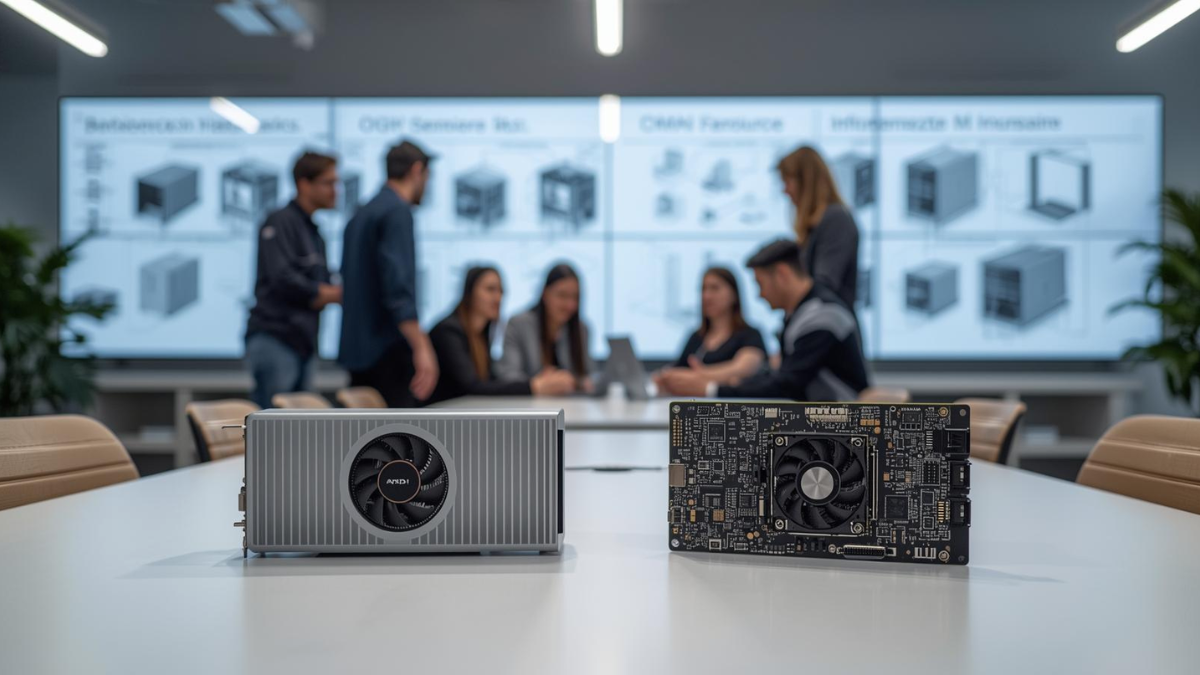
Developers review AI hardware and open-source workflows that highlight the growth of open-source AI infrastructure.
Imagine a world where the speed limit for every driver is set by a single, proprietary manufacturer. Their roads are superior, their service is unmatched, but to use them, you must commit to their ecosystem forever. For the last several years, this has been the reality for companies building the future of artificial intelligence.
The engine of this future is the Graphics Processing Unit, or GPU, and the manufacturer has been, almost exclusively, NVIDIA.
The company’s hardware is foundational, but its true power lies in open-source AI infrastructure, particularly its proprietary CUDA software stack. This combination created a high-performance moat around AI development.
Now, however, that dominance is under serious threat, not from a direct hardware competitor alone, but from a strategic coalition focused on fostering truly open-source AI infrastructure. Companies like AMD, with its robust hardware offerings, and Red Hat, the open-source champion, are leading a charge to democratize the AI development pipeline, moving the industry toward more scalable, less proprietary, and vendor-agnostic systems.
This shift matters because it determines who gets to build the next generation of AI and how much it will cost.
The CUDA Conundrum: Understanding the Moat
The technological heart of NVIDIA’s monopoly isn’t just the sheer speed of its silicon; it’s the open-source AI infrastructure barrier presented by CUDA. In simple terms, CUDA is a parallel computing platform and programming model that allows developers to write code that can run on NVIDIA GPUs.
For over a decade, it has been the gold standard for accelerating deep learning models.
The challenge is that CUDA is a walled garden. If you develop your AI model using NVIDIA hardware and the CUDA environment, switching to a different hardware provider later becomes a massive undertaking, often requiring a complete rewrite of core code.
This vendor lock-in has created a bottleneck, restricting competition and driving up the cost for everyone from hyperscale cloud providers to small startups.
The Rise of Open Standards and Scalable Alternatives
The counteroffensive is not about building a “better” GPU, though the hardware improvements are certainly crucial. The real strategy is tearing down the software walls. The focus is on establishing a truly open-source AI infrastructure that is vendor-neutral and portable.
AMD is actively developing ROCm, its open-source software platform that serves as a direct, non-proprietary competitor to CUDA. By collaborating with major enterprise Linux and cloud players, they are working to ensure that widely used AI frameworks like PyTorch and TensorFlow run seamlessly on AMD’s powerful Instinct GPUs.
The aim is a simple promise: develop your model using open tools, and it will run well on any compatible hardware, regardless of the brand.
Red Hat’s role is critical here. As the architect of open-source enterprise solutions, it provides the secure, manageable operating systems and Kubernetes orchestration necessary to deploy these models at scale in data centers and hybrid clouds.
Red Hat’s expertise in creating reliable, governed, and certified open-source AI infrastructure platforms is what bridges the gap between powerful hardware and the practical, enterprise-grade application of AI.
Democratizing AI and the Cost of Innovation
The shift to open-source AI infrastructure has two massive implications that reach far beyond the data center.
1. Lowering the Entry Barrier: The rise of powerful open-source models, such as various Small Language Models, means that organizations no longer need to spend billions training a massive, foundational model from scratch. They can take an existing model, fine-tune it on their own data, and deploy it.
But to deploy these models efficiently, they need affordable, scalable hardware not tied to a single vendor. Open standards allow companies to shop around, fostering true competition and significantly reducing the capital expenditure required to innovate. This is the democratization of AI.
2. Bolstering Resilience and Security: A single-source supply chain for critical technology creates a systemic risk. By breaking the monopoly, organizations gain supply chain resilience, reducing their vulnerability to geopolitical risks or single-vendor bottlenecks. Furthermore, open-source code can be audited, reviewed, and improved by a global community, often leading to more transparent and secure infrastructure than its proprietary counterparts.
The Road Ahead: A Hybrid Future
The competition will not result in a complete dethroning of the current leader overnight. NVIDIA’s lead in ecosystem maturity, optimization, and developer familiarity is immense. However, the movement toward open-source AI infrastructure signals a fundamental shift in market dynamics.
The future of AI infrastructure is likely hybrid. Organizations will use NVIDIA for specialized, high-end training tasks where their optimization is indispensable. Still, they will increasingly turn to AMD, Red Hat, and other open ecosystem players for large-scale, cost-effective inference and fine-tuning across their hybrid cloud environments.
This forces the entire industry to compete on pure performance, price, and openness, rather than relying on a proprietary lock-in.
The AI Infrastructure War is not a fight between two chipmakers; it’s a strategic pivot toward an open, collaborative, and competitive environment. For the enterprise, this means greater choice, lower cost, and the acceleration of AI innovation in every sector.
It ensures that the speed limit of technological progress is determined by ingenuity, not by a single company’s software stack. You should see this trend not as a technical skirmish, but as a critical development that will define the accessibility and economics of AI for the next decade.
About the Author