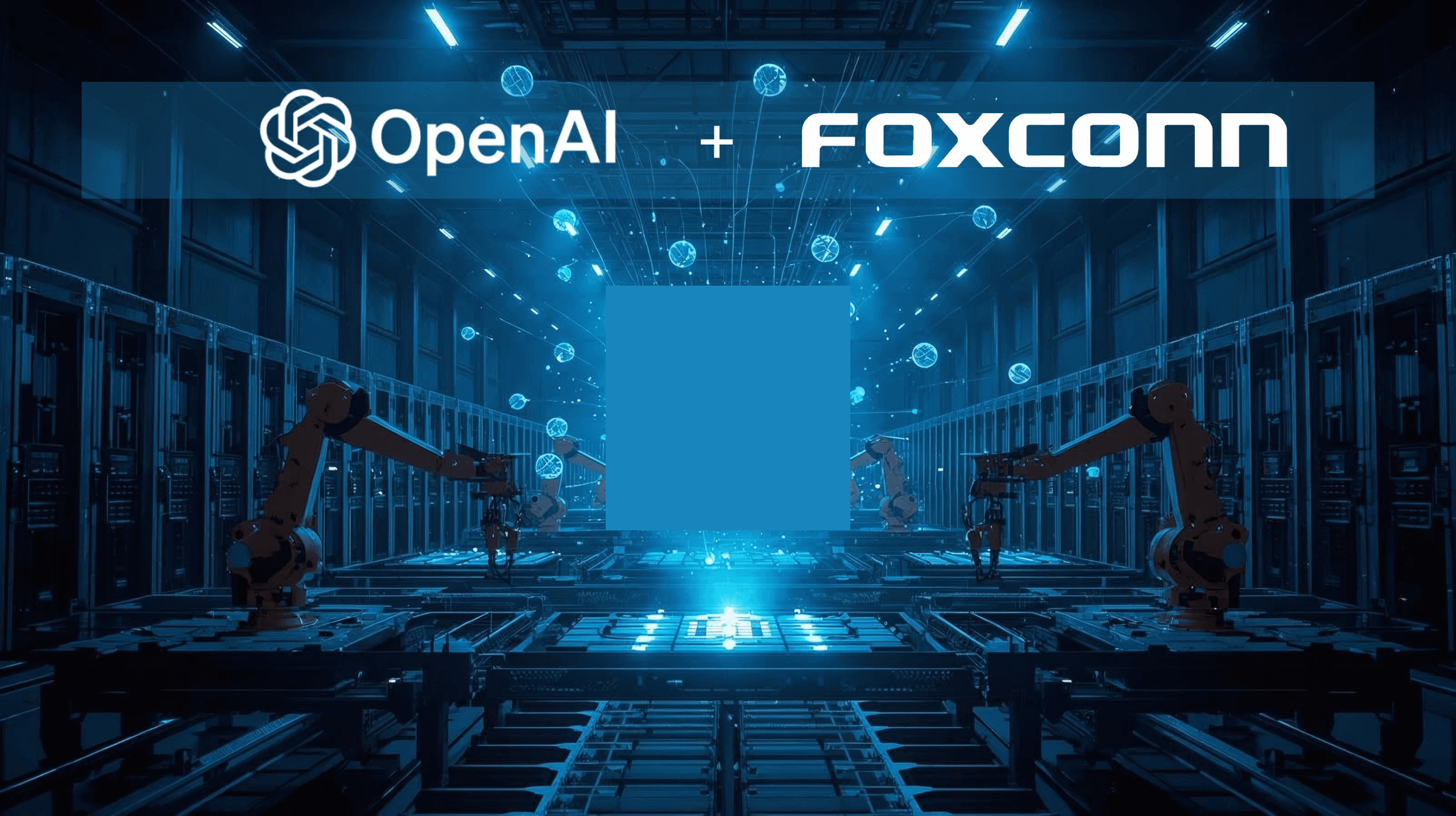
The OpenAI–Foxconn partnership signals a shift from virtual cloud compute to massive, AI-optimized physical infrastructure.
When we type a prompt into ChatGPT, the response feels like magic. It appears instantly on our screens, seemingly pulled from the ether.
However, the “cloud” is not actually a cloud at all. It is a physical network of steel, silicon, copper, and massive power consumption.
Now, the race to build the physical body for this digital brain has accelerated. The recently announced OpenAI Foxconn partnership marks a critical turning point in this race, shifting the focus from software code to the heavy industrial machinery required to run it.
For years, the conversation around artificial intelligence focused on algorithms and data. Today, it is shifting to infrastructure.
OpenAI has teamed up with manufacturing giant Foxconn to build high-performance computing centers directly in the United States. This move is not just about building faster computers.
It is about securing the physical supply chain for the most important technology of the century.
The Builders Meet the Architects
To understand the significance of the OpenAI Foxconn partnership, we have to look at the players involved. OpenAI is the architect, designing the intelligence models that the world uses daily.
Foxconn, formally known as Hon Hai Precision Industry Co., is the builder. They are the company that turned the iPhone from a design in California into a physical product in everyone’s pocket.
In this collaboration, Foxconn is expected to manufacture GB200 NVL72 server racks.
To use a simple analogy, think of OpenAI as the driver of a Formula 1 car. They know how to race and win. However, they need a specialized vehicle to do it.
The GB200 NVL72 is that vehicle. It is a massive, integrated server system powered by Nvidia chips, designed specifically to handle the immense computational load of training and running advanced AI models.
By partnering with Foxconn, OpenAI ensures they have a dedicated, experienced crew building these complex machines at a scale few other companies can manage.
Bringing the Factory Home
One of the most compelling aspects of the OpenAI Foxconn partnership is the geography. Reports indicate that this hardware will be manufactured in the United States, potentially utilizing Foxconn’s facilities in Wisconsin.
Why does location matter? For decades, hardware manufacturing has centered in East Asia. This created a logistical bottleneck and a geopolitical risk. If the supply chain is disrupted halfway across the world, AI development in the West could grind to a halt.
By moving production to US soil, this alliance achieves three things:
- Speed: It reduces the time between design and deployment.
- Security: It places critical AI infrastructure within domestic borders.
- Reliability: It mitigates the risks associated with global shipping and tariff uncertainties.
This strategy mirrors a broader trend where tech giants are realizing that software dominance relies heavily on hardware sovereignty. You cannot control the digital future if you rely entirely on others to build the physical machines that power it.
What Is at Stake?
The OpenAI Foxconn partnership highlights a reality that many overlook: AI is resource-intensive. We often discuss AI in terms of “intelligence,” but we should also discuss it in terms of electricity and heat.
The hardware Foxconn is building is incredibly dense and powerful. These systems generate massive amounts of heat and require sophisticated liquid cooling technologies to function.
This is where Foxconn’s expertise becomes vital. Assembling these “superchips” is not like snapping together LEGO bricks. It requires precision engineering to ensure that thousands of chips can communicate with each other instantly without overheating. If the hardware fails, the AI fails.
This deal signals that OpenAI is no longer just a software laboratory. It is evolving into a full-stack technology entity that cares as much about thermal dynamics and assembly lines as it does about neural networks.
The Future of Compute
We are entering the industrial phase of artificial intelligence. The initial experimental phase was about proving what the models could do. This new phase is about scaling that capability to a global level.
The OpenAI Foxconn partnership is the foundation for this expansion.
For the consumer, this means faster, more reliable AI tools. For the industry, it signals that the biggest bottleneck to AI growth is no longer just the code. It is the capacity to run the code.
Why It Matters
The collaboration between a top-tier AI lab and the world’s largest electronics manufacturer proves that the digital world is inextricably linked to the physical one.
The OpenAI Foxconn partnership is not just a business deal; it is a blueprint for how the next generation of the internet will be built. It reminds us that while AI lives in the cloud, the cloud lives in very real, very hot, and very expensive metal boxes.
Understanding this physical reality is key to understanding where technology is going next.
About the Author