


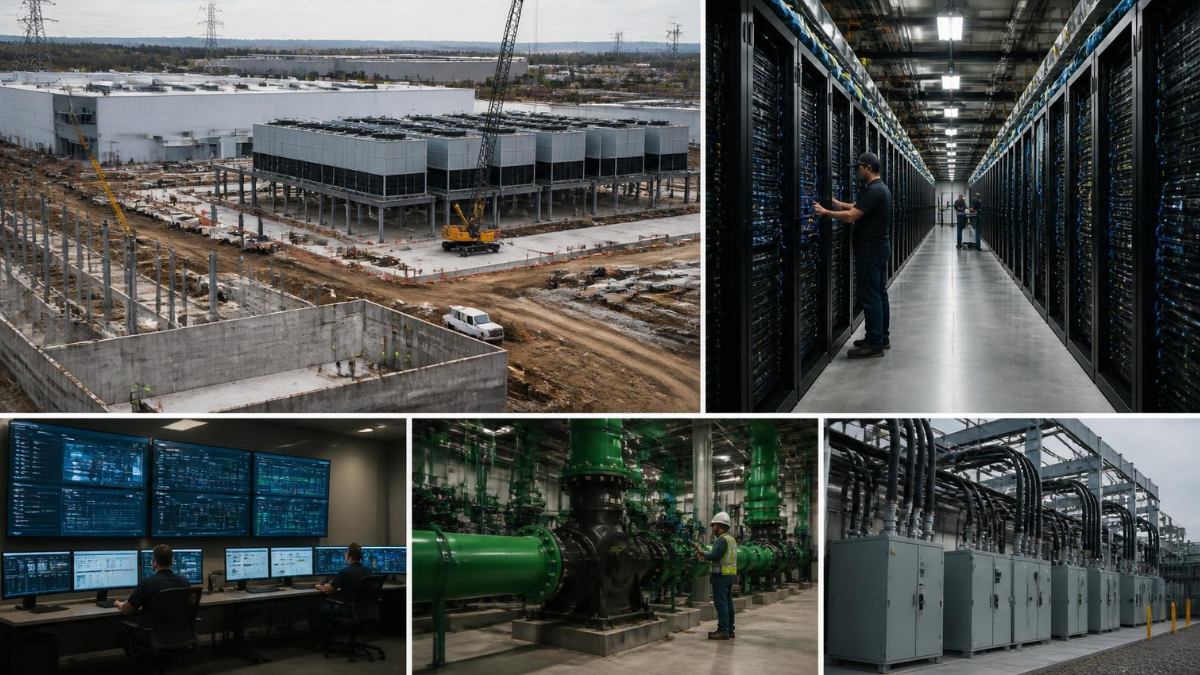
AWS is expanding data center, power, cooling, and computing infrastructure as demand for AI cloud capacity continues to grow.
AWS recorded its fastest growth in more than four years, but even Amazon’s planned $220 billion in capital spending will not provide enough computing capacity to meet the AI demand it expects this year.
AWS revenue increased 37% from a year earlier to $42.2 billion during the second quarter, exceeding analysts’ expectations and adding more than $4.6 billion from the previous quarter. Amazon CEO Andy Jassy said much of the AWS capacity scheduled for 2027 has already been reserved, while customers have also committed to some capacity planned for 2028.
AI Capacity Requires More Than Additional Servers
Cloud capacity refers to the computing resources AWS can make available to its customers, but expanding it requires much more than installing additional servers. Amazon must secure land, electrical connections, data center buildings, processors, memory, storage, cooling systems, and networking equipment before that capacity can be used.
AI adds another layer because training and running advanced models requires specialized accelerators supported by high-bandwidth memory and fast networks capable of moving large amounts of data between thousands of processors. A delay in any part of that infrastructure can reduce how much computing power AWS is able to deliver.
Amazon begins investing in new data centers about two years before they open, which means a larger capital budget does not immediately translate into additional AI capacity. Buildings, electrical infrastructure, and utility connections must already be in place before servers and networking equipment can be installed.
AI Demand Is Changing How Customers Plan
One of the clearest signs of today’s AI demand is how far in advance customers are reserving computing capacity.
Organizations developing large AI models or deploying AI across their businesses cannot always wait until new infrastructure becomes available. Instead, many are securing computing resources years ahead to help ensure capacity will be available when their projects are ready to move into production.
That helps explain why Amazon said much of its planned AI capacity for 2027 has already been reserved, with some customer commitments extending into 2028. Those reservations are less about buying cloud services early and more about securing access to computing resources that may be difficult to obtain later.
AWS also reported a backlog of $496 billion in contracted business, providing another indication of the long-term demand customers are placing on its cloud infrastructure.
Power Has Become Part of the Cloud Equation
Electricity is becoming one of the biggest factors influencing how quickly AI infrastructure can expand because modern AI data centers consume far more power than traditional cloud facilities.
The International Energy Agency estimates that worldwide data center electricity use will roughly double between 2025 and 2030, while electricity use by AI-focused facilities will triple. Those facilities also require additional cooling, electrical distribution equipment, and grid capacity before they can begin operating.
This helps explain why expanding AI capacity is no longer simply a technology challenge. Building the infrastructure now depends on construction projects, utility providers, electrical equipment, and specialized hardware arriving at the right time.
These are challenges being addressed across the cloud industry, with providers investing heavily to expand AI infrastructure while working through many of the same physical and operational requirements.
Higher Spending Reflects Long-Term Infrastructure Planning
Amazon increased its 2026 capital spending forecast from about $200 billion to $220 billion, with higher memory costs accounting for much of the increase. The company spent $53.1 billion during the second quarter, primarily on AWS and generative AI infrastructure.
Those investments have already affected Amazon’s free cash flow, although AWS continued generating strong operating income during the quarter.
AWS’s latest results illustrate how rapidly enterprise AI demand is growing, but they also show that meeting that demand depends on much more than adding servers. Building AI cloud infrastructure now requires years of planning, electrical infrastructure, specialized hardware, data center construction, and customer commitments that increasingly extend well before the computing resources become available.
About the Author

