


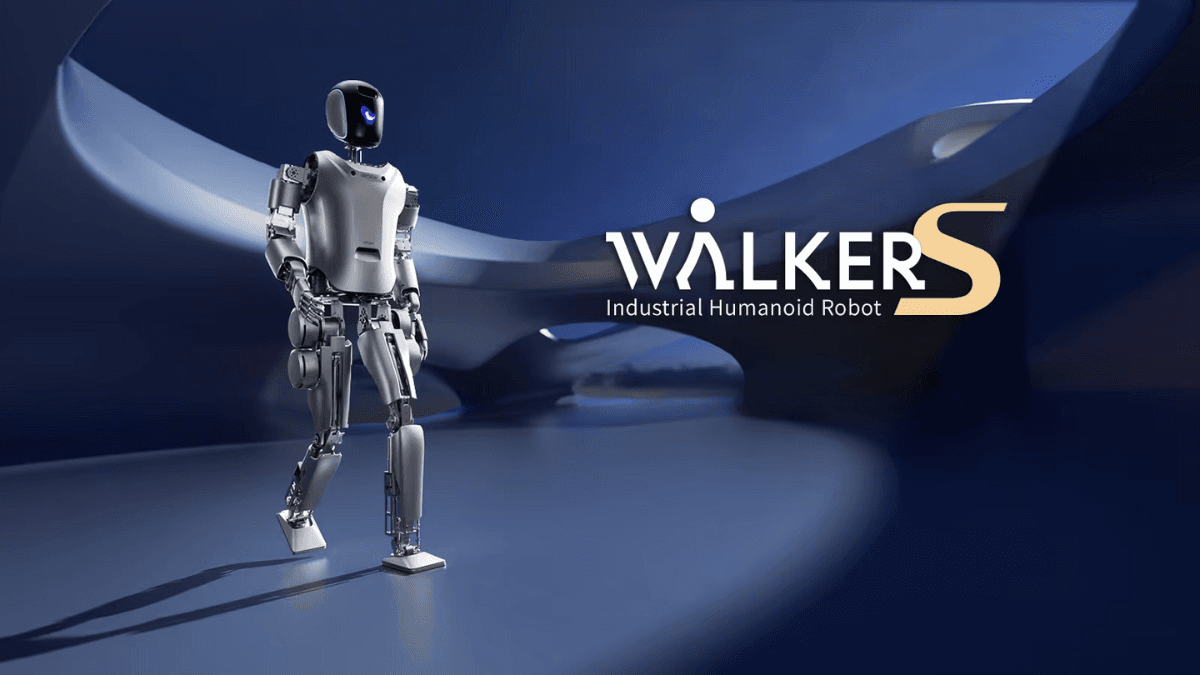
Chinese Robot Walker S
When China’s Walker S humanoid robot set a Guinness World Record for the longest continuous walking distance, a staggering 66 miles, achieved in just over 54 hours, it was more than a quirky headline. It was a clear, calculated signal.
The Chinese robot race is moving from theoretical ambition to demonstrated endurance, and it’s raising the stakes for the future of global automation and strategic competition.
This record, achieved by a robot built by the Chinese startup UBTech, isn’t about winning a walking competition. It’s a tangible metric of advancement in critical underlying technologies: battery life, balance control, thermal management, and, most importantly, gait stability over long durations.
These are the unsung engineering hurdles that determine if a robot is merely a lab curiosity or a functional tool capable of deployment in real-world environments, like factories, warehouses, or disaster zones.
The Engineering Feat Behind the Endurance
To understand the significance, consider the challenge of sustained bipedal motion. A human manages this effortlessly, but a robot relies on a complex feedback loop.
Engineers must constantly calculate how to shift the center of gravity while compensating for the uneven forces of motion, which is exponentially harder over dozens of hours. A slight miscalculation, and the robot falls.
The Walker S’s success suggests a mature integration of several key systems:
- Gait Planning and Control: This involves predictive algorithms that adjust the robot’s steps in real time. Think of it like a highly precise, always-on autopilot. Unlike wheeled or tracked robots, bipedal stability requires constant computation of torque and momentum.
- Battery and Power Management: Walking for 54 hours demands an extremely dense and highly efficient power source. This record points to a substantial leap in battery technology and optimization, a core technological battleground in the broader electrification and automation landscape.
- Joint Actuation and Thermal Control: Each joint needs a powerful actuator, the robotic equivalent of a muscle, that must operate continuously without overheating or failing. Sustained performance highlights robustness and advanced cooling systems.
Beyond the Walk: Strategic and Societal Implications
The ultimate goal of the Chinese robot race is not simply building better humanoids, but establishing technological supremacy in industrial automation. China, facing the economic challenges of a rapidly aging population and rising labor costs, is strategically positioning robotics as a solution for labor shortages.
In 2023, China’s Ministry of Industry and Information Technology (MIIT) released guidelines aiming to achieve mass production of humanoid robots by 2025. This record demonstrates the rapid, state-supported execution toward that goal.
For the U.S. and other nations, this is a wake-up call. While American companies like Boston Dynamics have often dominated headlines with impressive, high-speed demonstrations, the Chinese approach emphasizes durability, endurance, and rapid commercialization for the domestic market, a crucial distinction in the Chinese robot race.
The long walk signals that these complex machines are closer to becoming reliable, around-the-clock workers. This will drastically reshape factory floors, logistics, and even public services. The key impact will be seen in supply chain resiliency; robots that can operate for days on end fundamentally change the economics of manufacturing, reducing dependence on human shift cycles.
Ethically, this endurance raises the stakes on the integration of robots into society. A robot capable of operating for 54 continuous hours presents a unique set of challenges regarding worker displacement, security, and human-robot interaction, requiring thoughtful policy creation to manage the societal shift now clearly on the horizon.
The View Forward
The 66-mile walk is the new benchmark for sustained robotic performance. It shifts the focus from flashy agility to industrial durability. This is a crucial pivot point, demanding that global competitors look past demonstration videos and focus on the gritty engineering of endurance and reliability.
The real Chinese robot race isn’t about the speed of a sprint, but the distance of a marathon. The world must now consider how to respond to a technology that is not just fast or nimble, but tirelessly persistent.
About the Author

