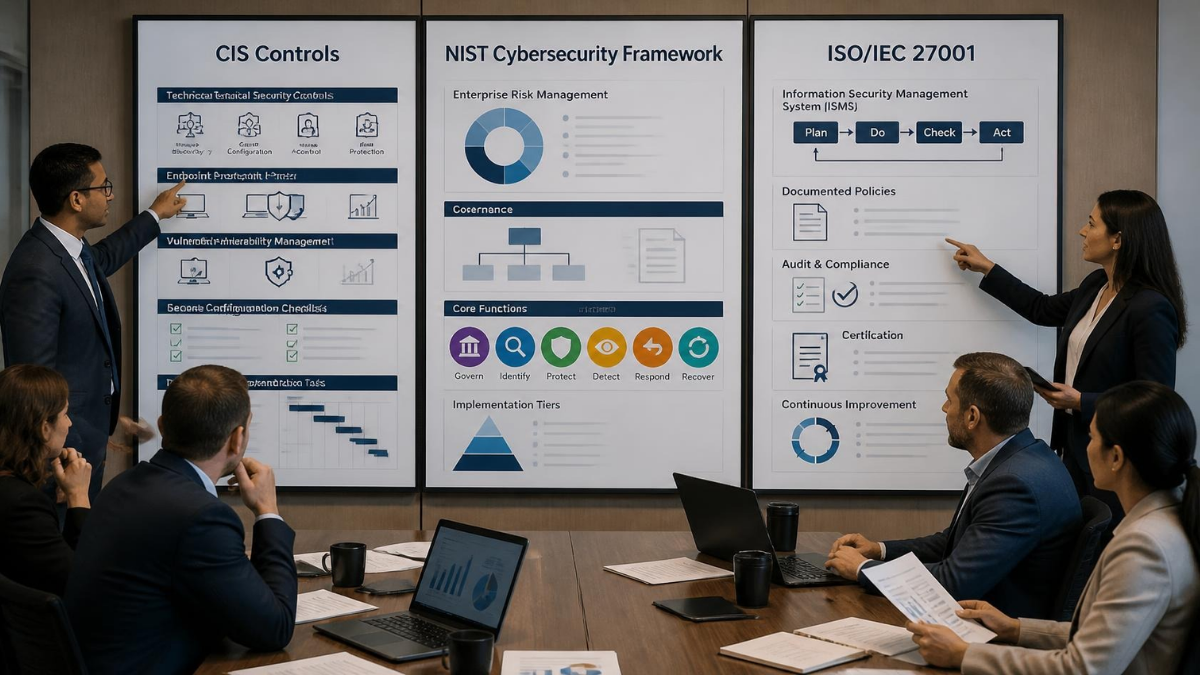
CIS, NIST, and ISO provide different approaches to technical controls, risk management, and information security certification.
One of the most common questions in cybersecurity is whether an organization should adopt CIS, NIST, or ISO. The question sounds simple, but it starts from the wrong place. These frameworks were designed to solve different problems, so the better question is: What problem are you trying to solve?
Understanding that difference makes choosing the right framework much easier.
CIS Focuses on Technical Security Controls
The Center for Internet Security (CIS) Controls provide a prioritized set of technical safeguards designed to reduce the most common cyber risks. Rather than creating a broad security program, CIS focuses on the actions security and IT teams can implement to strengthen systems.
The controls are organized into Implementation Groups (IG1 through IG3), allowing organizations to adopt security measures based on their size, resources, and cybersecurity maturity. That practical approach has made CIS a popular starting point for small and medium-sized organizations that want clear technical guidance without building an entire governance program first.
NIST Focuses on Managing Cybersecurity Risk
The NIST Cybersecurity Framework takes a broader view by helping organizations manage cybersecurity risk across the business.
Instead of prescribing specific technical controls, NIST organizes cybersecurity into six core functions: Govern, Identify, Protect, Detect, Respond, and Recover. Those functions help organizations understand what should be managed, how cybersecurity supports business objectives, and how risk should be evaluated over time.
Because of its flexibility, the framework is widely used across both government and private industry.
ISO 27001 Focuses on Building a Security Management System
ISO/IEC 27001 approaches cybersecurity from a different direction by establishing an Information Security Management System (ISMS).
An ISMS defines how an organization manages information security through documented policies, processes, responsibilities, continual improvement, and risk management. Unlike CIS or NIST, ISO 27001 also supports formal third-party certification, allowing organizations to demonstrate that their security management system has been independently audited against an internationally recognized standard.
That certification is often important for organizations operating globally or working with customers that require formal proof of security governance.
The Differences Become Clear When Compared
Although all three frameworks improve cybersecurity, they serve different purposes.
CIS tells organizations what technical safeguards to implement first.
NIST helps organizations manage cybersecurity risk across the enterprise.
ISO 27001 provides a structured management system that can be independently certified.
Those differences explain why comparing them as if one replaces the others often creates confusion.
Cost and Resource Considerations
The three frameworks also differ in the level of investment they typically require.
CIS Controls and the NIST Cybersecurity Framework are available free of charge, making them attractive options for organizations that want to strengthen their security posture without purchasing a standard. The primary investment is the time and resources needed to implement the recommended practices.
ISO/IEC 27001 requires purchasing the standard and, for organizations seeking certification, paying for external audits and ongoing certification assessments. Building and maintaining an Information Security Management System also requires a greater organizational commitment because it extends beyond technology into policies, processes, documentation, and continual improvement.
Geographic and Business Considerations
The environment in which an organization operates can also influence which framework makes the most sense.
Organizations operating primarily within the United States often adopt the NIST Cybersecurity Framework because it aligns well with U.S. government agencies, critical infrastructure sectors, and many domestic regulatory and contractual requirements.
Organizations with an international presence, multinational customers, or global compliance requirements frequently adopt ISO/IEC 27001 because its certification is recognized worldwide and provides a common security standard across multiple countries.
CIS Controls are widely used regardless of geography because they focus on technical security practices and complement either framework.
Many Organizations Use More Than One Framework
Choosing one framework does not always mean excluding the others.
Many organizations use NIST to guide cybersecurity governance, ISO 27001 to establish and maintain their Information Security Management System, and CIS Controls to implement technical safeguards that reduce day-to-day cyber risk.
Each framework contributes a different part of the overall cybersecurity program, allowing them to complement one another rather than compete.
Understanding the purpose behind each framework makes the decision much clearer. Once you identify the problem your organization needs to solve, choosing the appropriate framework, or combination of frameworks, becomes much easier.
About the Author