


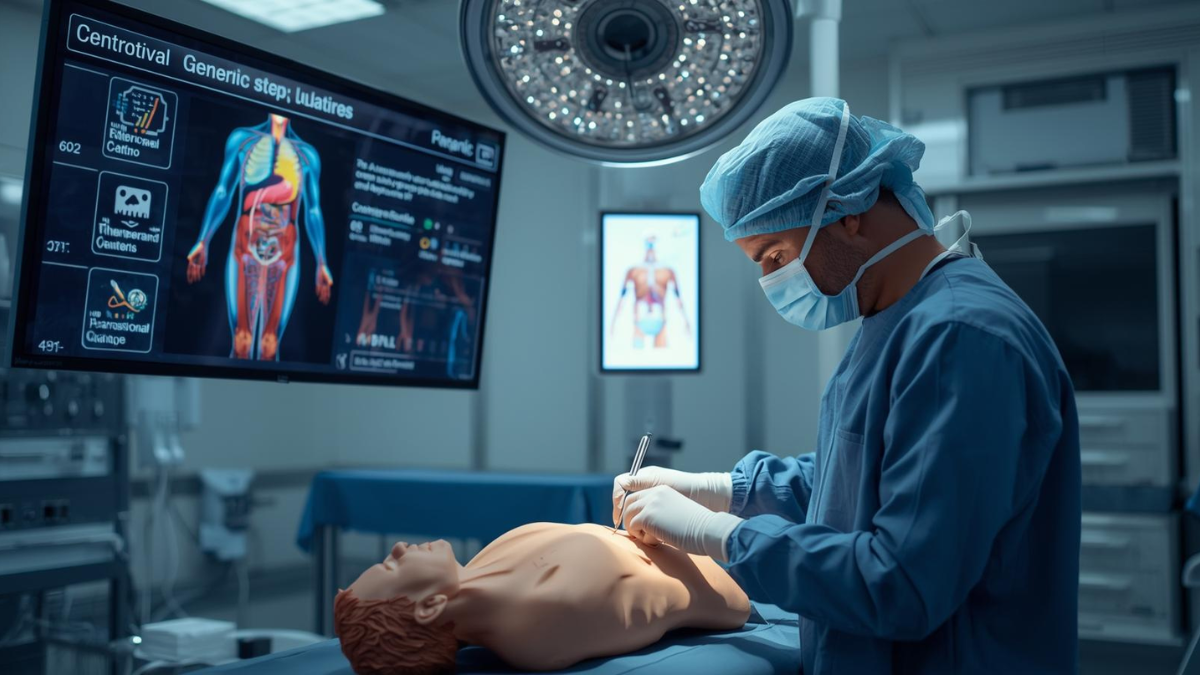
A surgical trainee receives AI-driven, personalized guidance that reflects the rise of hyper-personalized healthcare.
Imagine a future surgeon stepping into a virtual operating room, guided not by a human mentor, but by an AI tutor that knows their strengths, weaknesses, and learning pace better than anyone. Hyper-personalized healthcare, once an ambitious concept, is rapidly becoming a reality as artificial intelligence moves from simply reading scans to reshaping how doctors are trained and how diseases are diagnosed.
Hyper-personalized healthcare is at the heart of this transformation, making medical education and diagnostics smarter, safer, and more exact than ever before.
Today, hyper-personalized healthcare is making headlines for the way it uses AI to adapt learning and care in real time. Instead of one-size-fits-all instruction, medical students can now practice with intelligent tutoring systems that deliver tailored feedback, simulate complex procedures in VR, and create unique learning journeys based on each user’s performance and skill progression.
The same principles that let music apps guess your taste are being used to coach future surgeons; except mistakes here could mean more than a bad playlist. AI-driven learning is becoming not just a supplement but a core component of medical training, promising to raise the standard of care for patients everywhere.
Unlocking the Next Era in Medical Training
At its core, hyper-personalized healthcare leverages adaptive learning platforms powered by AI. These platforms are trained to recognize subtle patterns in learners’ behavior, skill acquisition, and progression.
Intelligent tutoring systems (ITS) map out custom curricula for individuals, automatically adjusting the difficulty and content based on real-time performance. For example, when a surgical resident struggles with a particular step in a virtual operation, the AI can pause, offer targeted feedback, and even switch up the teaching strategy, all without judgment or fatigue.
Real-life studies show that AI-powered tutors like the Virtual Operative Assistant are not just novel; they work. Trainees practicing with AI tutors scored higher and advanced more quickly than peers trained by remote human instructors.
The systems provided metric-based assessments, setting measurable performance goals and giving actionable feedback. In practice, this translates to more consistent and precise skill development, narrowing the gap between novice and expert.
Privacy, Ethics, and Diagnosis: The New Frontiers
Yet the promise of hyper-personalized healthcare goes beyond better training. Patient safety and privacy are key concerns in an AI-driven world.
Enter federated learning, a breakthrough that enables AI models to learn from sensitive medical data such as EEG brain signals for early dementia detection, all without that data ever leaving a secure hospital or device. Instead of pooling information in one central server, federated learning allows each institution or edge device to train the AI locally, sharing only model updates, not raw patient data.
This dramatically reduces privacy risks while enabling highly accurate diagnostics, with recent models achieving close to 97% accuracy for EEG-based dementia prediction. This advance blends machine intelligence with patient trust.
As AI systems begin to influence both who learns medicine and how quickly doctors master new techniques, questions of equity and access arise. Will these tools be available everywhere, or only in elite centers?
With data-driven, adaptive feedback, AI could help level the playing field, identifying and supporting at-risk trainees before they fall behind. But it could also introduce new forms of bias or widen gaps if not developed mindfully.
Human Touch in the Digital Age
Despite all the advances, research shows the best results come when AI works in tandem with human instructors. When educators use AI-generated data to fine-tune their feedback, both the speed and safety of skill acquisition improve.
Instead of replacing educators, the role of mentors is evolving; they become interpreters of data, motivators, and coaches, focusing on the human aspects that no algorithm can replicate. The combination of real-time, AI-driven insights and empathetic human guidance is shaping the next generation of medicine.
Reflective Insight
The leap from image recognition to true hyper-personalized healthcare is not just about faster diagnosis or smarter classrooms. It is about creating a medical ecosystem where technology recognizes individuality, of both doctor and patient, empowering each with insight, precision, and empathy.
As we continue to unlock AI’s potential in medicine, the challenge will be to keep care as human as it is advanced, making every algorithmic leap one that ultimately serves health, dignity, and trust.
About the Author

