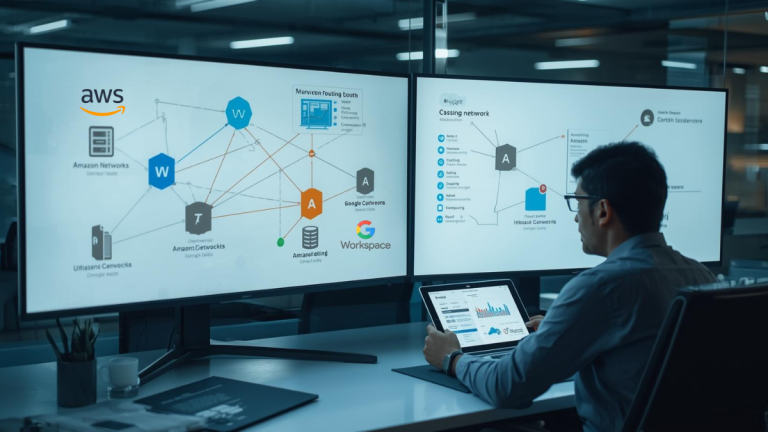
An engineer analyzes cloud-based quantum computing activity, reflecting the importance of the quantum computing cloud.
In 2011, a handful of scientists in laboratories were whispering about a new kind of machine, one that leveraged the weird, paradoxical rules of subatomic physics to calculate problems no traditional supercomputer could ever touch.
That machine, the quantum computer, was then an expensive, cryogenic enigma, locked away from the business world. Today, the story is fundamentally changing. The advent of the Quantum Computing Cloud marks a pivotal shift, moving this revolutionary technology from the research lab directly to the enterprise desktop.
This topic matters now because the long-anticipated bottleneck for accessing quantum power has finally been broken. Cloud providers have begun offering Quantum Computing as a Service (QCaaS), a model that democratizes access by letting businesses rent time on cutting-edge quantum processors without requiring billions in hardware investment.
This mainstreaming is set to unlock innovations in everything from drug discovery to materials science, and its impact will ripple across every sector that depends on complex calculations.
Decoding the Quantum Engine
To understand why this move is significant, we must first grasp the core difference between the familiar classical computer and its quantum cousin. A classical computer uses bits, which are like tiny light switches that can be either on (1) or off (0). All of our digital life is built on these definite states.
A quantum computer, however, uses quantum bits, or qubits. Imagine those light switches can be both on and off simultaneously, a state called superposition. Furthermore, two or more qubits can become linked, sharing the same fate even when separated by great distances, a phenomenon known as entanglement.
Because qubits can hold multiple values at once and work together in complex ways, a quantum computer can explore a vast number of potential solutions to a problem concurrently. Think of a maze: a classical computer must try every path sequentially, while a quantum computer can explore all paths at the same time, finding the solution exponentially faster for certain types of problems.
To simplify it, this is the difference between a single flashlight sweeping a dark room versus turning on the sun.
The Cloud Bridge: Why Accessibility is Everything
Until recently, engaging with quantum computing meant either partnering with a specialized research institution or having the capital to build and maintain a complex, ultra-cold system. QCaaS changes the equation completely.
When a company uses the Quantum Computing Cloud, they are essentially sending a problem to a distant quantum processor over the internet. The entire operation, from translating the classic code into quantum circuits to managing the delicate environment of the hardware, is handled remotely by the cloud provider.
This dramatically lowers the barrier to entry, allowing businesses in finance, logistics, and chemistry to experiment with quantum algorithms right now.
The real-world stakes are enormous. In materials science, researchers can simulate molecular interactions with a precision previously impossible, accelerating the development of new superconductors or high-performance batteries.
In pharmaceuticals, drug discovery currently involves testing millions of compounds; quantum algorithms can model these compounds with unprecedented accuracy, identifying promising candidates faster and more efficiently.
This shift is not about replacing traditional computers; it is about providing a powerful, specialized tool for specific, high-value, computationally intractable problems.
The Bigger Picture: Strategic and Societal Implications
The move of quantum power to the cloud is not without its strategic and ethical implications. On the strategic side, a quantum talent gap is already apparent. The technology is now accessible, but the skills to program and effectively use it remain rare.
Companies that invest early in training or specialized partnerships will gain a significant competitive edge in the coming years.
From a security standpoint, the very power of these machines poses a future threat to current encryption methods, an issue known as the “Q-Day” threat. While current quantum computers are not yet powerful enough to break modern cryptography, the cloud model accelerates research and development, forcing an immediate, worldwide shift toward “post-quantum cryptography,” which is resistant to both classical and quantum attacks.
The accessibility of the Quantum Computing Cloud means the countdown to this shift has just sped up.
The era of specialized computing has begun. Just as no single company needs to build its own massive data center thanks to the general-purpose cloud, very few will need to build their own quantum lab. This cloud model ensures that the power of quantum mechanics will be a utility, accessible to innovators everywhere.
The Takeaway
The Quantum Computing Cloud is more than a technological upgrade; it is an economic and scientific inflection point. By making quantum mechanics an on-demand service, we are transforming a scientific marvel into a practical business tool.
The critical question for leaders is no longer if quantum computing will matter, but how their organization will leverage this newly accessible power to solve the problems that were once deemed unsolvable. The future is here, and it is running on the cloud.
About the Author