


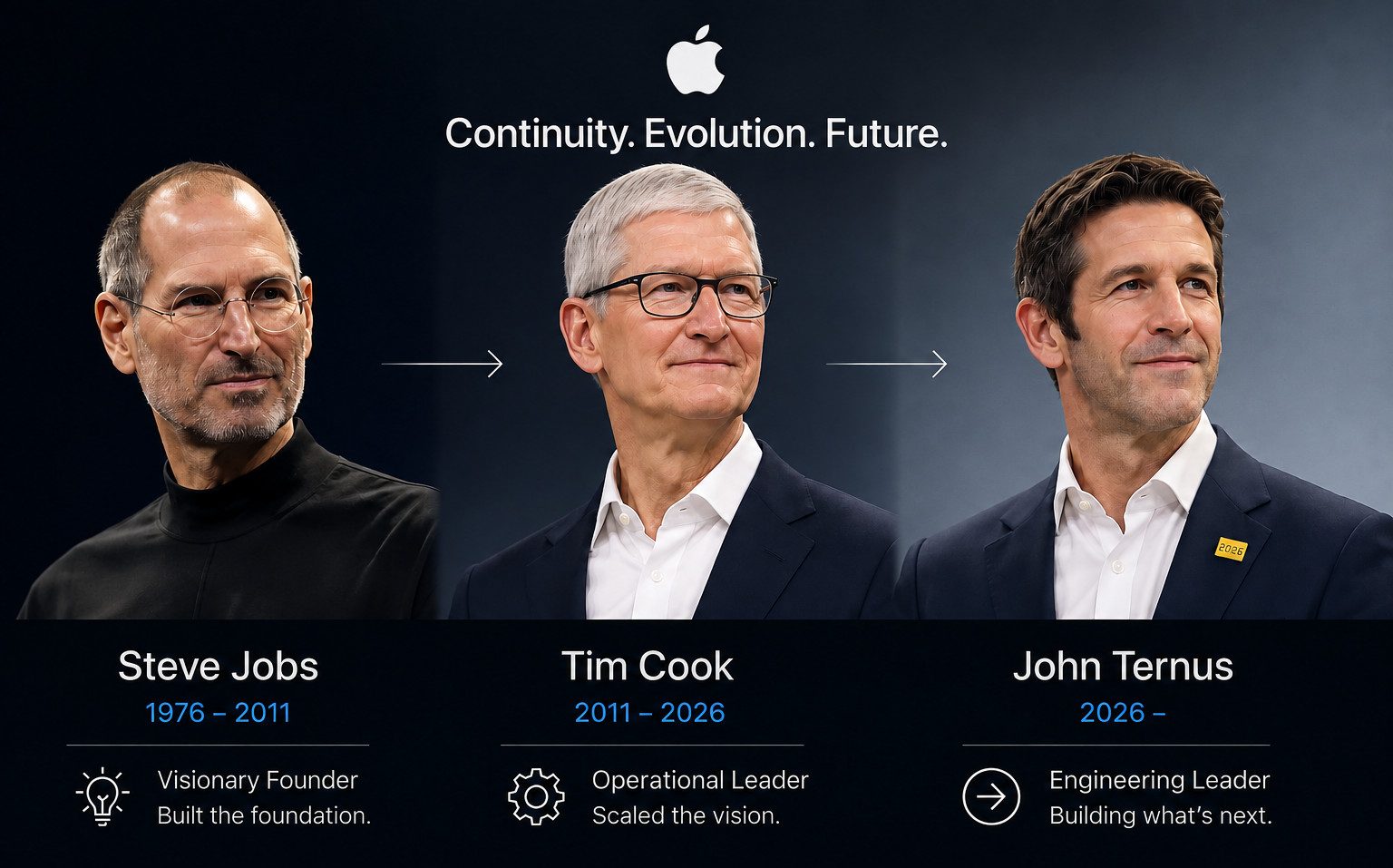
Three leaders, three different backgrounds. Steve Jobs built the foundation, Tim Cook scaled Apple into a global behemoth, and John Ternus now takes responsibility for what comes next.
John Ternus takes command of Apple today, and he inherits a situation only one executive has ever faced: following the man who successfully followed Steve Jobs.
Apple announced in April that Ternus would become CEO on September 1, with Tim Cook moving to executive chairman after 15 years leading the company. Ternus arrives from Hardware Engineering, where he spent years close to the products that remain at the center of Apple’s identity.
That background will invite comparisons with Jobs, particularly after an era led by an executive whose career was rooted in operations.
Apple has been through this kind of comparison before, when Cook succeeded Jobs in 2011. Cook faced the difficult task of following a founder whose name had become closely associated with the company and its products and remained inseparable from its public identity.
Cook came to the job with a different background. Before becoming CEO, he had built much of his reputation around Apple’s operations, manufacturing and supply chain. He also brought a different personality and management approach to the role.
Jobs understood that difference. According to Cook, Jobs told him before the transition that he should avoid asking what Jobs would have done and simply do what was right.
Cook followed that advice. He led Apple according to his own strengths, and the company that Ternus inherits shows what happened during those 15 years.
Apple’s market value grew from roughly $350 billion when Cook became CEO to more than $4.5 trillion as he leaves the position, and the annual revenue reached $416 billion in fiscal 2025, with $112 billion in profit.
We’ve seen Apple’s growth during those 15 years went beyond its financial performance. Services developed into a substantial business, Apple Watch and AirPods expanded the product portfolio, and Apple moved the Mac away from Intel processors through the development of its own silicon.
Cook did not recreate the Apple that Jobs had already built. He took responsibility for it and continued building from there.
That distinction now becomes relevant to Ternus because Cook has created his own succession problem.
From Impossible Shoes to Another Enormous Pair
Cook once had enormous shoes to fill. His success came partly from resisting the need to wear them.
Now he leaves an enormous pair of his own.
That leaves Ternus with a very different challenge. He takes over a company worth more than $4 trillion, with one of the world’s most valuable brands, a vast installed base and a collection of products and services that reaches across personal computing, communications, entertainment, health and financial services.
He also takes over at a time when Apple’s position in the next generation of computing is less established.
Artificial intelligence has changed the competitive environment around personal technology, and Apple has spent the past few years trying to define how AI belongs inside its products. The company also continues to manage manufacturing exposure to China while expanding production elsewhere, and it faces the continuing challenge of finding new sources of growth at a scale capable of influencing a company this large.
Those conditions give Ternus a different Apple from the one Cook received in 2011.
They also make his hardware background particularly interesting.
Ternus joined Apple in 2001 and has spent 25 years inside the company. His responsibilities have included hardware engineering across the iPhone, iPad, Mac, Apple Watch and AirPods, and he played an important role in the Mac’s transition to Apple silicon.
It is easy to look at that history and see the possibility of Apple returning to a more product-centered CEO after the Cook era. His engineering background may influence the decisions Apple makes, particularly as AI becomes increasingly integrated into the devices people already use.
But Ternus has spent his career inside both the Jobs and Cook versions of Apple. His experience was formed by each of them, while his responsibility now extends beyond both.
The Ternus Version of Apple
We now get to see what Ternus does with the Apple he inherited.
We already know what Jobs brought to Apple, and 15 years of Cook have given us enough evidence to understand what his leadership brought to the company. Ternus begins without that history as CEO, so comparisons with either predecessor can only take us so far.
His first major Apple product event arrives only days into his tenure, with the next iPhone launch scheduled for September 9. There will be products to evaluate, strategic decisions to follow, and eventually enough evidence to understand where he intends to take the company.
The early decisions may also tell us how much his engineering background influences Apple’s approach to AI. Apple does not necessarily need an AI product separate from the rest of its portfolio. Ternus could pursue a future in which AI becomes increasingly embedded across the hardware and software ecosystem that Apple already controls.
Whether that becomes his direction remains to be seen.
The more revealing development will be whether a recognizable Ternus approach begins to emerge from those decisions. Cook showed that successful succession at Apple could preserve what had been built while allowing a new CEO to lead according to his own abilities.
Ternus now has the opportunity to do the same.
Jobs left enormous shoes to fill, and Cook succeeded without trying to become the person who had worn them. Fifteen years later, Cook leaves behind an Apple that makes his own shoes equally difficult to fill.
Ternus does not need either pair.
If his tenure eventually succeeds on its own terms, the Apple he leaves behind will tell us what he brought to the company. And perhaps his successor will someday face exactly the same problem.
About the Author

